Table of contents
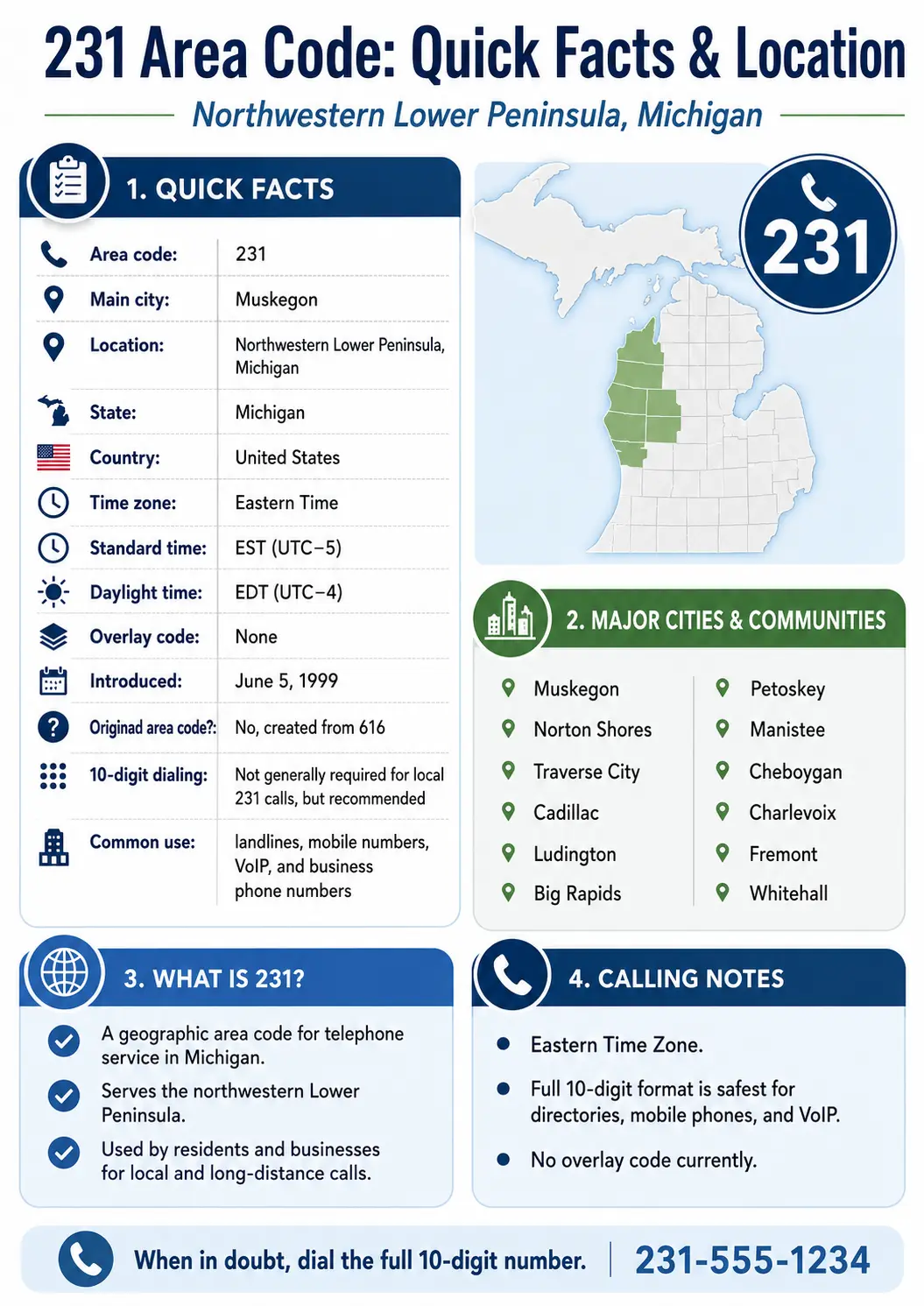
Quick Facts About the 231 Area Code
Detail
Information
- Area code
- 231
- Location
- Northwestern Lower Peninsula, Michigan
- Main city
- Muskegon
- Country
- United States
- State
- Michigan
- Time zone
- Eastern Time
- Standard time
- EST, UTC−5
- Daylight time
- EDT, UTC−4
- Overlay codes
- None
- 10-digit dialing
- Not generally required for local 231 calls, but recommended
- Original area code?
- No, created from area code 616
- Introduced
- June 5, 1999
- Common use
- Michigan landlines, mobile numbers, VoIP, and business phone numbers
What Is the 231 Area Code?
The 231 area code is a North American area code that covers Michigan. It mostly includes the northwestern part of Michigan's Lower Peninsula, including cities and communities near Lake Michigan.
It is a geographic area code (not a toll-free number), so the 231 number is usually used for a person, business or organization in a particular part of Michigan.
Where Is Area Code 231 Located?
Area code 231 is a telephone area code in Michigan, USA, that encompasses most of the northwestern portion of the Lower Peninsula and is associated with West Michigan and northern Michigan communities.
Major places served by the 231 area code include:
- Muskegon
- Norton Shores
- Traverse City
- Cadillac
- Ludington
- Big Rapids
- Petoskey
- Manistee
- Cheboygan
- Charlevoix
- Fremont
- Whitehall
The area code is particularly known for communities located on or near the shores of Lake Michigan, including tourist communities of tourism, small cities, local business districts, residential subdivisions, and seasonal communities.
What Time Zone Is the 231 Area Code In?
The 231 area code is part of the Eastern Time Zone. In standard time, it uses EST (UTC−5), and in daylight saving time, it uses EDT (UTC−4).
Businesses, customer support teams and remote callers will find this relevant as Michigan is 1 hour ahead of Central Time and 3 hours ahead of Pacific Time.
Is 231 a Michigan Area Code?
Yes, Area Code 231 is a Michigan Code. Not related to Detroit, Grand Rapids, or the Upper Peninsula. Rather, it serves the northwestern part of the Lower Peninsula, including Muskegon and Traverse City.
It is possible to get a call from a 231 number that is truly from Michigan. But area code alone is not an indication of the caller's physical location since caller ID can be spoofed.
History of the 231 Area Code
The 231 area code was established to meet the growing demand for phone service in western and northern Michigan.
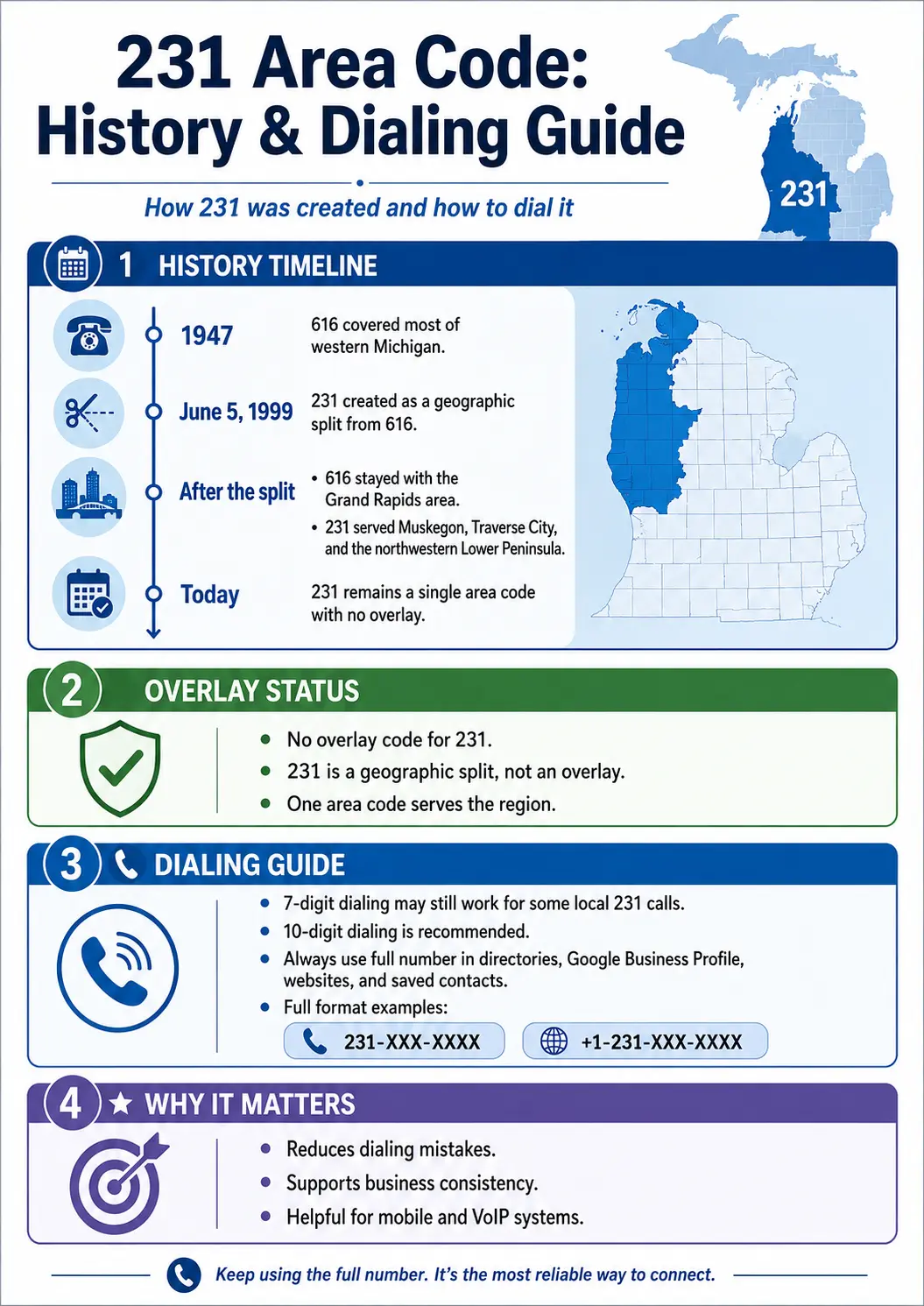
Prior to 231: The 616 area code covered most of western Michigan. 616 was in need of relief as population growth and business expansion, along with fax machines, mobile phones, and Internet-based phone services, drove up demand.
The area code 231 was established as a geographic split of the 616 area code and went into service on June 5, 1999.
The northern part of the 616 area code got a new area code: 231.
After the split, 616 is still used for Grand Rapids and its surrounding area while 231 is used for Muskegon, Traverse City and most of the northwestern part of Lower Michigan.
231 is a geographic area code split, as opposed to an overlay, many of today's new area codes are.
231 is one of Michigan's “old” area codes today.
What Are the Overlay Codes for 231?
There is currently no area code overlay in the 231 area code. This means that none of the other area codes has the same geographic area as many large metropolitan areas do.
Many other areas in the country now have more than one area code for the same geographic area; however, 231 is still a single Michigan area code.
Do You Need 10-Digit Dialing for 231?
Although 231 is not an overlay area code at this time, seven digit dialing may continue for many local calls within the 231 area. For various practical reasons, however, ten-digit dialing is still recommended:
- Numbers are usually stored and dialled in full ten digits on a mobile phone
- VoIP systems are frequently designed to accept a full ten-digit phone number to send a phone call.
- This means that a telephone call made outside the local calling area needs to be connected with the area code.
- The full number should always be listed on business directories and Google Business Profile listings.
- Giving the complete number will minimize dialing mistakes on calls from outside Michigan.
Note that Michigan's 2021 mandatory ten-digit dialing was in effect for area codes 616, 810, 906 and 989, and not 231.
Is the 231 Area Code Legit or a Scam?
The 231 area code is a completely legal area code used by residents, businesses, schools, clinics, contractors, tourism businesses, and local organisations throughout Michigan.
But scammers can spoof any area code. Spoofing enables criminals to make caller ID show nearly any name or telephone number, including a local, familiar number.
A call from 231 is not necessarily suspicious, but it is always prudent to be alert when a caller asks for funds, passwords, banking information, gift cards or personal information.
Common 231 Scam Warning Signs
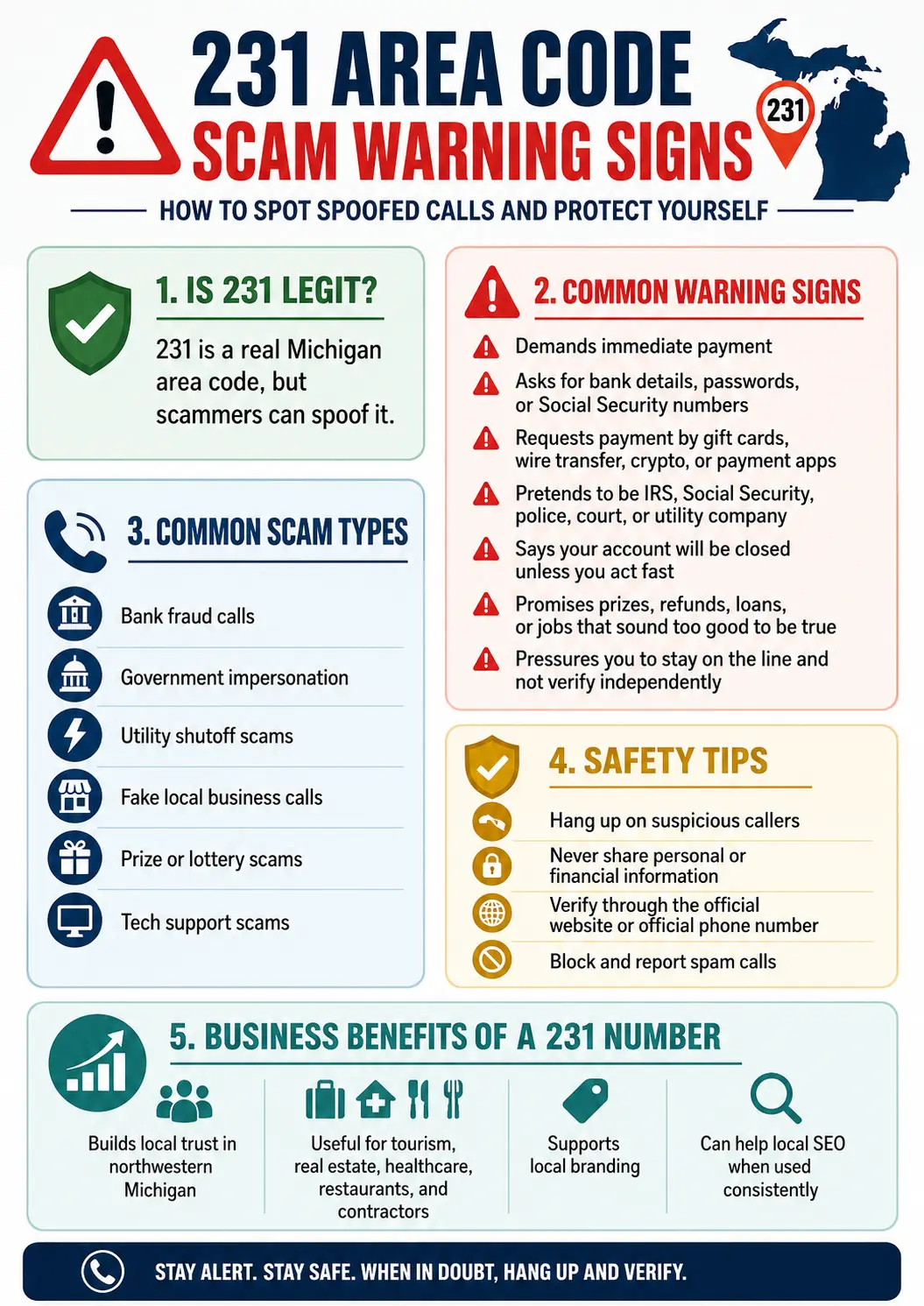
If the caller is a 231, be careful:
- Accuses you of owing money and insists on prompt payment
- Requests bank information, debit card numbers or online banking information
- Asks to be paid via gift card, cryptocurrency, wire transfer or payment apps
- Pretends to be from the IRS, Social Security Administration, police, a court or a utility company.
- Notifies you that your account will be closed unless you take quick action
- Promises some reward, refund, loan or employment that seems too good to be true
- Persuades you to stay on the line and not end the call
- Does not permit you to independently verify his/her identity on an official Website or via an official phone number
According to the FCC, caller ID spoofing occurs when a caller knowingly alters caller ID information to conceal their real identity.
What Are the Common Scams Linked With Spoofed 231 Numbers?
Fraudulent 231 numbers can be used for the same kinds of scams as are used elsewhere in the U.S. Common examples include:
1. Bank Fraud Calls
The caller pretends to be from the bank, says there is suspicious activity on your account, and asks you for your PIN, login code, card number, or banking password.
2. Government Impersonation Scams
The caller says they are from the IRS, the Social Security Administration, law enforcement, or a court, and that the account is about to be suspended, that they will arrest you, or that they will impose fines unless you take action now.
3. Utility Shutoff Scams
The caller tells you that your electric, gas, internet or telephone bill will be disconnected if you don't pay up now, and in an unusual way.
4. Fake Local Business Calls
Phishing calls are some that pretend to be from a contractor, insurance company, medical office and/or service provider in the same area or neighborhood as the target to make them more believable and relatable.
5. Prize and Lottery Scams
The caller informs you that you've won a prize; however, you must pay a fee, tax, or shipping for the prize to be released.
6. Tech Support Scams
A caller pretends to be from a computer software, telephone, or online account company, saying your computer, phone, or account has been hacked and you need to pay a fee to give the caller access to it or install a program.
What Are the Benefits of a 231 Area Code Number?
The 231 number can be a valuable resource for individuals and businesses associated with northwestern Michigan.
Key benefits include:
- Firms up the local brand in Michigan's market
- Supports your customers in identifying your business as local and community-oriented
- Especially helpful for businesses located in Muskegon, Traverse City, Ludington, Cadillac, Petoskey, and surrounding areas.
- Establishes a sense of trust with customers who would like to work with local businesses
- Great for tourism, real estate, home services, healthcare, restaurants, legal services, and local contractors
- Can be used as a landline, mobile, VoIP or business phone number
How a 231 Area Code Number Can Benefit Your Business' Local SEO?
When applied consistently across your online presence, the area code 231 can help with local SEO.
Google's Business Profile guidelines suggest using a local phone number if possible, and the number is directly under the business's control, as opposed to a central call center number.
A 231 number can be beneficial for local SEO, as it can:
- Help make your business more relevant to consumers in northwestern Michigan
- Local trust displayed on your Website, Google Business Profile, citations and directory listings.
- Having uniformity of NAP (name, address and phone number) information across all platforms
- Boosting the confidence of callers who want to use local providers
- Assisting businesses in the service area with marketing to communities like Muskegon, Traverse City, Cadillac, Ludington and Petoskey.
While a local number in itself won't help you rank higher, it can boost your local presence when paired with accurate business listings, genuine customer reviews, location-specific pages, and consistent contact information.
Can You Get a New 231 Number Today?
Yes, if you have a 231 area code number available from your phone carrier or VoIP provider, you can get a new 231 number today. Availability may fluctuate as phone numbers are allocated in groups and not all may be available in all exchanges or cities. If the 231 number plays a crucial role in your enterprise, you can improve your chances of finding one by searching several carriers, mobile, landline and VoIP service providers.
How Can You Get a New 231 Area Code Number?
To get a 231 area code number, follow these steps:
- Pick a telephone service provider that provides Michigan local telephone numbers
- Look for numbers in the 231 area code that are available for you to use.
- Choose the number that is suitable for your business or private use
- Determine what type of business phone system is required: mobile, landline, VoIP, or cloud-based
- Install call forwarding, voicemail, texting or team extensions as necessary
- Place the number on your Website, Google Business Profile and any pertinent local directories
- Ensure your phone number is the same in all your business listings
If you have an existing business number, check with your provider to see whether number porting is available so you can keep your number when switching to a new provider.
Final Thoughts
The 231 area code is a valid Michigan area code that services the northwest Lower Peninsula, including Muskegon, Traverse City, Cadillac, Ludington, Big Rapids, and other areas. It was established in 1999 from the 616 area code, and is vital to the region for residents and businesses alike.
For companies, a 231 number can help build area trust and a genuine Michigan identity. The important thing for callers to keep in mind is that 231 is completely legitimate, but scammers can spoof any number. Check any unusual phone calls before giving out personal or financial details.
Frequently Asked Questions (FAQs): 231 Area Code
1. Is the 231 area code a scam?
No. 231 area code is a valid Michigan area code. But scammers can use 231 numbers to make calls or texts look local and trustworthy, according to complaints from Michigan residents in various online communities.
2. Why do I get calls from 231 area code?
This could be from a real person, a local Michigan business, a robocaller or someone using caller ID spoofing. Scammers often use an area code because people are more likely to pick up the phone when it's familiar.
3. Should you call back missed calls from 231 numbers?
If you dialed a number that you don't know and there was no voicemail, don't dial it again to check. If it is an important call, the caller will usually leave a clear message or contact you from a legitimate source.
4. Is the 231 area code spoofable?
Yes. Using caller ID spoofing, scammers can place a call from a different area code and have it appear as a 231 area code, making the call more likely to be accepted.
5. What is the meaning of a random 231 text message?
While this may be a simple case of a wrong number, it might also be the first step of a wrong-number scam. These scams will start with a seemingly innocent message and then slowly make their way toward romance, cryptocurrency trading or investment scams.
6. Can you answer a random 231 text?
In most cases, not responding is the best way to deal with the sender and can prevent further spam texts or an increase in scams.
7. How do some scam calls sound like genuine calls?
Some fraud operations employ prerecorded voices, or even AI-generated or well-reasoned dialogues that sound natural and conversational, making it more difficult to flag them as scams at the moment.
8) Are all 231 calls Michigan-based?
Not necessarily. Michigan is assigned a 231 area code, but with caller ID spoofing, it's possible for a caller from anywhere in the world to show 231 on their phone.
9. What if a 231 caller asks for money or personal information?
Hang up or end the conversation. Do not provide bank information, passwords, verification codes, SSN or payment information. If the caller says they're from a bank, a utility company or a government office, call that office using its official, independently verified contact information.
10. What can I do to minimize 231 numbers calling?
Block the number, report it as spam, activate the anti-spam feature built into your cell phone, and consider blocking calls from unknown numbers. Fraudsters often change the numbers they use for their frauds, so blocking one number will not stop others.
11. Is it a good number for a business if it has 231?
Yes. For northwestern Michigan, a 231 number can be especially effective, as customers in Muskegon, Traverse City, Cadillac, Ludington, and Petoskey are more likely to recognize and trust a phone number with the 231 area code.
12. How can I check if a 231 business call is a genuine one?
Look on the company's Website, Google Business Profile, invoice or email signature. If the caller urges you to act quickly or asks for sensitive information, be suspicious, and check on the organization's identity on your own before doing anything.
Share
SEO Expert, AEO & GEO Specialist
Muneeb Maqsood is an SEO Expert, AEO & GEO Specialist with over 5 years of experience focused on delivering measurable business growth. He helps brands improve search visibility, attract qualified leads, and most importantly, convert organic traffic into paying customers through strategic, intent-driven optimization.