Table of contents
Quick Facts About the 301 Area Code
Detail
Information
- Area code
- 301
- Location
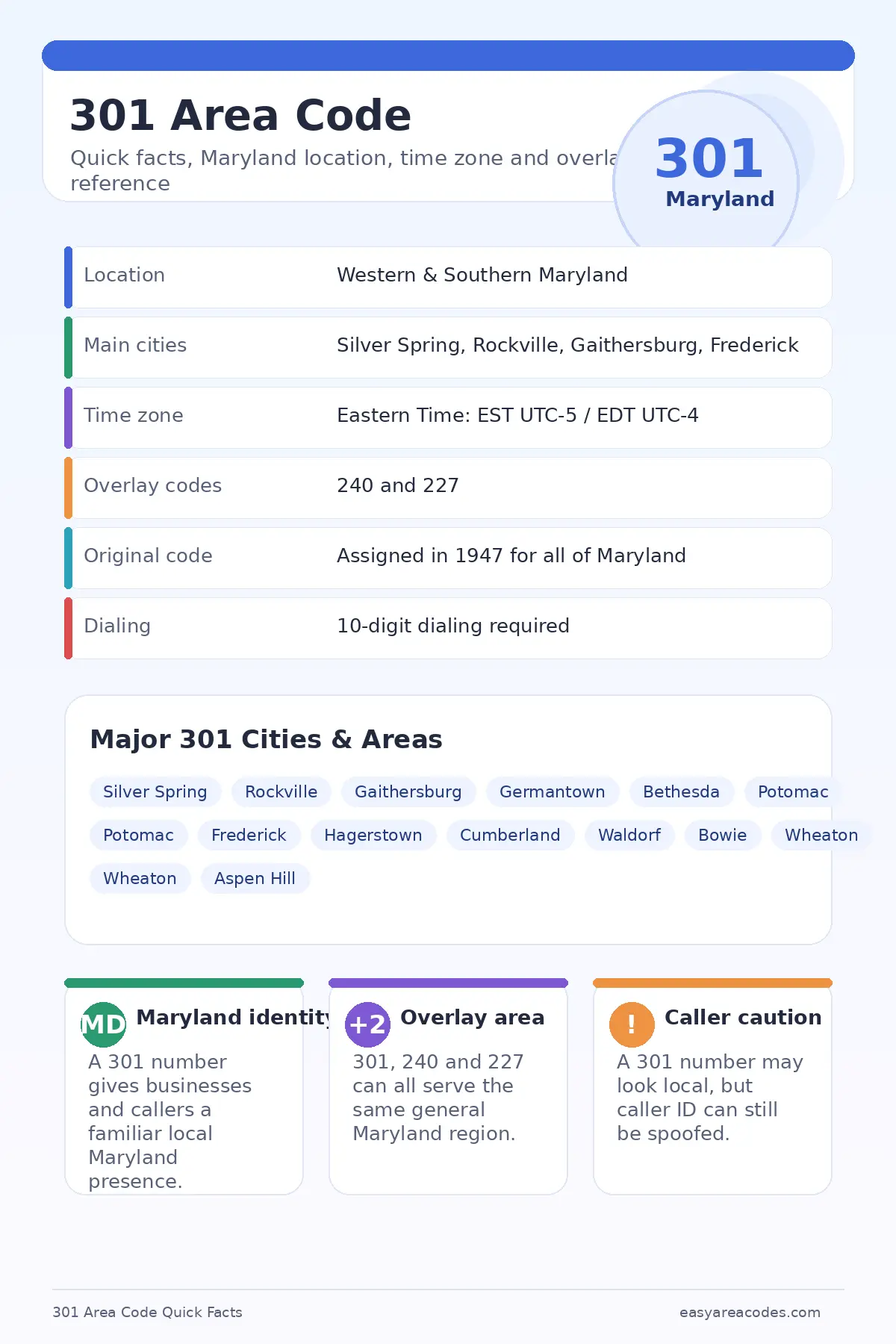
- Western Maryland, Southern Maryland, and parts of the Washington, D.C. metro area
- Main cities
- Silver Spring, Rockville, Gaithersburg, Germantown, Frederick, Bethesda, Hagerstown, Waldorf
- State
- Maryland
- Country
- United States
- Time zone
- Eastern Time
- Standard time
- EST, UTC−5
- Daylight time
- EDT, UTC−4
- Overlay codes
- 240 and 227
- 10-digit dialing
- Required
- Original area code?
- Yes, assigned in 1947
- Common use
- Landlines, mobile numbers, VoIP numbers, business lines, and local Maryland phone numbers
What Is the 301 Area Code?
The 301 area code is a telephone area code that serves local phone numbers in western Maryland, southern Maryland, and portions of the Washington, D.C. metropolitan area.
It is one of the oldest area codes in the North American Numbering Plan. These 301 numbers are currently in use by residents, businesses, government departments, service providers, and VoIP users in a host of Maryland communities.
Maryland cities like Silver Spring, Rockville, Frederick, Gaithersburg, Germantown, Bethesda, Hagerstown, and Waldorf are commonly associated with a 301 number.
Where Is Area Code 301 Located?
301 is an area code that serves Maryland, United States, primarily in the western and southern regions of the state, and in the Maryland suburbs of the Washington, D.C. area.
The 301 area code is found for all or portions of:
- Montgomery County
- Prince George’s County
- Frederick County
- Washington County
- Allegany County
- Garrett County
- Charles County
- St. Mary’s County
- Parts of Howard, Carroll, and Anne Arundel counties
The 301 area is served by major cities and communities:
- Silver Spring
- Rockville
- Gaithersburg
- Germantown
- Bethesda
- Potomac
- Frederick
- Hagerstown
- Cumberland
- Waldorf
- Bowie
- Wheaton
- Aspen Hill
The 301 area code is very familiar in Maryland due to the area being part of the busy suburbs, government-related areas, business districts, and residential communities.
What Time Zone Is the 301 Area Code In?
301 is part of the Eastern Time Zone. For regular time, it is in the Eastern Standard Time (UTC−5) zone, and for daylight saving time, is in the Eastern Daylight Time (UTC−4) zone.
For 301 numbers, businesses should set up calls, customer service hours and appointments based on Eastern Time.
Is 301 a Maryland Area Code?
Yes, 301 is a Maryland area code and it used to be the first area code assigned to Maryland.
In 1947, when the North American area code system was implemented, 301 covered the whole state of Maryland. As time passed and the population expanded and the need for telephone numbers expanded, Maryland got more area codes and overlays.
Today, 301 is still very much a part of Maryland — western Maryland, southern Maryland, the Maryland side of the Washington, D.C. metro area.
History of the 301 Area Code
The area code 301 has a rich history as one of the original area codes in the United States.
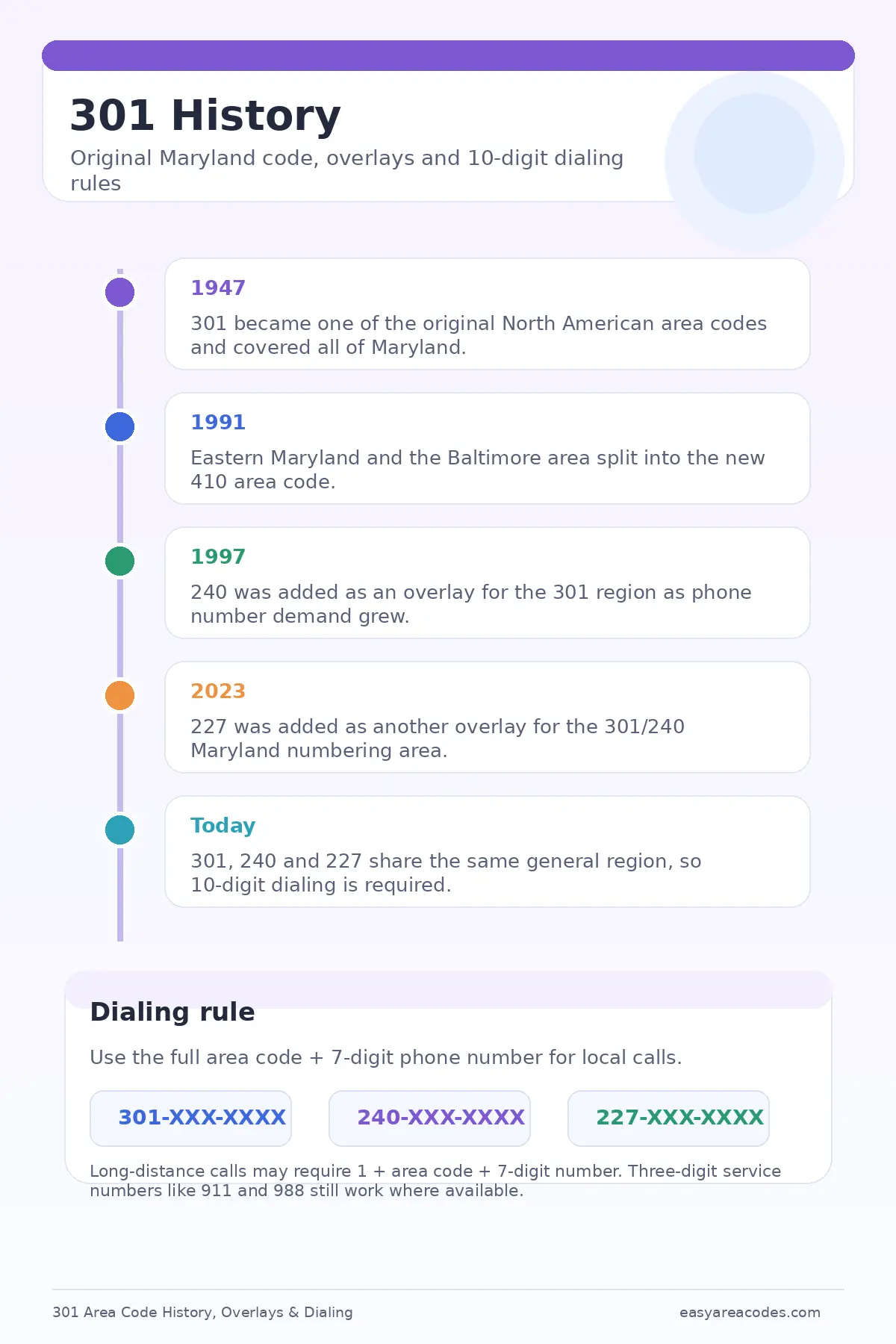
1947: Area code 301 was one of the original North American area codes, which was assigned to all of Maryland.
In 1991, the eastern and Baltimore area parts of Maryland were removed from 301 and placed into a new area code, 410, which drastically cut back 301's geographic territory.
1997: When the demand for phone numbers in the 301 area grew, to be served by adding an overlay area code 240. With this addition, local callers had to use 10-digit dialing.
2023: Area code 227 was added as another overlay for the 240/301 area code.
Today, Area codes 301, 240, and 227 all serve the same general area of Maryland, and new phone numbers may be allocated from any of these three area codes based on availability.
The development of 301 mirrors the tremendous growth Maryland has experienced in population, business activity, mobile phone usage, and VoIP over the last few decades.
What Are the Overlay Codes for 301?
An overlay is an area code with multiple service territories at the same time. New area codes aren't overlaid on top of old area codes, but rather on top of the current area code.
With regard to the 301 region in particular:
- Areas with the code 301 were originally part of the 201 area code.
- The first overlay was added, 240.
- Later, 227 was added, as well as new phone numbers, so that people could continue to use them.
Consequently, two people in the same Maryland city can share the same area code - 301, 240, or 227 - and live in the same general area.
Do You Need 10-Digit Dialing for 301?
Yes, 10-digit dialing has been mandated throughout the 301 area code region. You have to dial the area code and the seven-digit telephone number for all calls (you should use the full area code, for example, 301-XXX-XXXX).
Since 301 is in an overlay area, the area code must be used in local calls. It is possible that the call is not connected if the caller dials only seven digits.
Long-distance numbers may require you to dial: 1 + area code + seven-digit number.
Where possible, three-digit dialing for standard service numbers (911, 988, 211, 311, 411, 511, 611, 711, and 811) will continue to work.
Is the 301 Area Code Legit or a Scam?
The 301 area code is a perfectly valid code. It is an actual area code that is used by people, companies, schools, government, medical and other area services in Maryland.
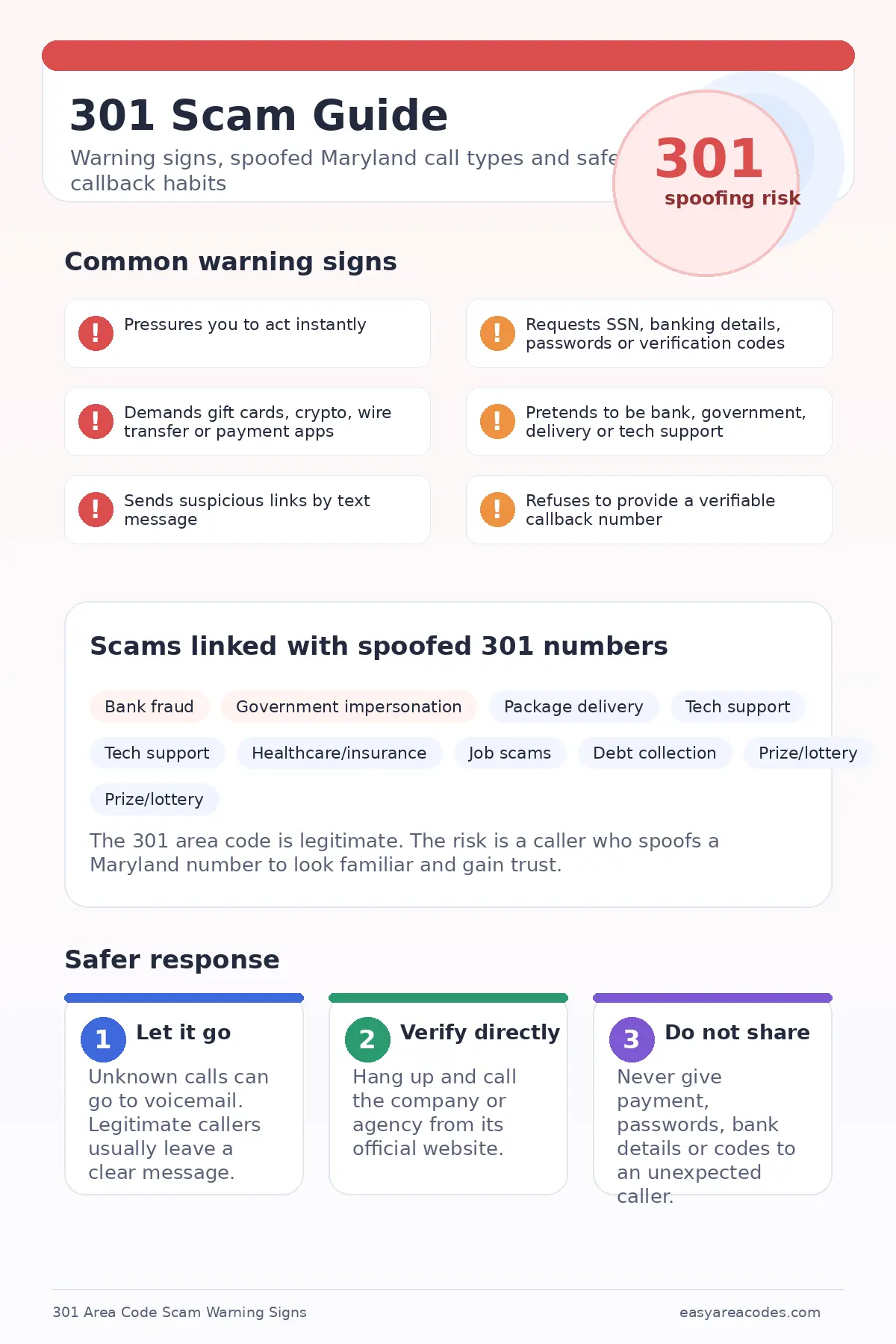
Scammers can and do spoof 301 numbers, however, so fraudulent calls may look as if they are coming from a familiar number in Maryland, but be based in a different location entirely.
A 301 number does not necessarily mean trouble, but it's always wise to be vigilant when a stranger asks for funds, personal information, passwords, banking information, or requests your urgent attention.
Common 301 Scam Warning Signs
If a 301 number calls you and exhibits any of the following warning signs, be careful:
- The caller puts you under pressure to act instantly, without having the time to think about it
- They say that you are in debt and need to pay immediately
- They ask for your Social Security number, bank information, password, or verification numbers
- They demand payment with gift cards, cryptocurrency, wire transfer, or payment apps
- They threaten to close your account if you don't respond immediately.
- The caller won't give a verifiable company name, web page, or callback number.
- Suspicious links are included in the message or text.
- The caller pretends to be from a bank, government, delivery, or tech support, and cannot be verified
- The offer or opportunity seems too good to be true
- The caller is rude and/or aggressive when you ask questions.
The best thing to do is hang up and call the company or agency directly via a recognized website or phone number.
What Are the Common Scams Linked With Spoofed 301 Numbers?
Spoofed 301 numbers are employed in a number of fraudulent schemes. Common examples include:
1. Bank Fraud Scams
The caller pretends to be from your bank and says there's some unusual activity on your account and asks for your account number, card number, PIN or a one-time verification code.
2. Government Impersonation Scams
The caller impersonates the IRS, the Social Security Administration, a police department or government agency, claiming a legal action, arrest, fine, or suspension of accounts will occur unless immediate payment is made.
3. Package Delivery Scams
You get a phone call or text message saying a package is overdue or needs confirmation. A fake tracking link is given to obtain your personal or monetary data.
4. Tech Support Scams
The caller claims the computer, phone or online account has been hacked and requires you to download software to allow them to access your device or pay for nonexistent technical support.
5. Healthcare or Insurance Scams
The caller pretends to be a Medicare benefits provider or health insurance or a prescription discount provider. They usually collect information related to your personal or insurance details.
6. Job and Work-From-Home Scams
A fake 301 calls you claiming to offer you a job, and asks you to pay money for up-front reasons, or to provide identifying paperwork or banking details.
7. Debt Collection Scams
Fake debt collectors pretend that you owe them money and that if you don't pay them now, they'll take you to court. Legitimate debt collectors are obliged to give you clear and verifiable information under the law.
8. Prize or Lottery Scams
You receive a call saying you've won a prize, but you have to pay a fee or give the caller personal information before you can collect it. No real prizes ask for any payment up front.
What Are the Benefits of a 301 Area Code Number?
A 301 area code number can be a valuable asset to both individuals and businesses. Key benefits include:
- Local Maryland identity: A 301 number indicates that the company has already been established in Maryland, which can be a huge boost for local customers.
- Trust with local customers: People are more likely to answer calls from familiar, recognizable area codes.
- Better regional branding: Companies can use a 301 number to establish a meaningful relationship with customers in Montgomery County, Prince George's County, Frederick, Rockville, Silver Spring, and beyond.
- Professional communication: Customer support, sales, appointment setting, and requests for general business information.
- VoIP flexibility: A bunch of providers let businesses use 301 numbers, even when the team is on the move.
- Stronger local marketing: A number of advertisements, landing pages, and business profiles give a more local touch and make them more relevant and credible to Maryland audiences.
- Customer convenience: Local customers feel more comfortable calling a familiar-looking local number.
How a 301 Area Code Number Can Benefit Your Business’s Local SEO
If your business caters to people throughout Maryland, a 301 number can be useful to your local SEO plans.
Here is how it can help:
Builds Local Relevance
Having the same 301 number on your website, Google Business Profile, citations, and local directory listings helps bolster your association with the Maryland service area in your customers' and search engines' eyes.
Improves Trust on Local Landing Pages
If your business is in the area and you're serving Rockville, Silver Spring, Frederick, Bethesda, Gaithersburg, or other nearby cities, then having a 301 number can create a more local presence and give your landing pages more credibility to visitors.
Supports NAP Consistency
The NAP — name, address, and phone number — consistency is an essential local SEO factor. Keeping the same 301 across your website, directories, social profile, and business listings helps to establish credibility and clarity to the search engines.
Helps Local Customers Recognize Your Business
Maryland residents are more likely to receive calls from a familiar local area code and trust and respond to them. This can help you gain better leads and strengthen your customer communication.
Useful for Service Area Businesses
Plumbers, electricians, real estate agents, law firms, healthcare offices, cleaning companies, contractors, consultants, and other local service providers will benefit most from having a 301 number.
While a 301 number alone won't ensure better search results, it can certainly complement a sound local SEO plan, especially if you develop accurate listings, have genuine customer reviews, create location specific pages, produce quality content and build strong local links.
Can You Get a New 301 Number Today?
Depending on the provider and the number stock, it may be possible to get a new 301 number today.
As an older well-established area code, there may be restrictions on new numbers in some exchanges of the 301 area code. Often providers will provide a 240 or 227 number instead, as both overlays serve the same Maryland area.
If a specific 301 number is important to you, make sure to check with mobile phone operators, VoIP, business phone services, local telecom service providers and virtual number companies. Even if 301 is not available, a 240 or 227 phone number may be able to give a completely legit area code in Maryland.
How Can You Get a New 301 Area Code Number?
To get a new 301 area code number, follow these steps:
- Select a phone service provider — Select a mobile phone service provider, VoIP provider, virtual phone service, or business phone system that meets your needs.
- Search Maryland numbers — Opt in for Maryland as your desired area, and search for numbers.
- Ask for the 301 area code — If the provider offers area code selection, ask for 301 and see what's offered.
- Look at different options — There are different options when it comes to numbers for businesses, such as standard numbers, vanity numbers, or easy-to-remember combinations.
- Set up call features — Add voicemail, call forwarding, call recording, auto-attendant, SMS, team extensions, etc.
- Update business listings: Include the number on your website, Google Business Profile, local directories, social profiles, and in your email signature.
- Use the same number in all platforms — maintain the same number in all platforms so that customers would not be confused, and trust is built.
If a 301 number is not available, a 240 or 227 number will also cover a general overlay area and give the same local Maryland presence.
Final Thoughts
The 301 area code is one of the most popular and historic area codes in Maryland. It has been operating since 1947 and continues to have strong connections with western Maryland, southern Maryland, and the Washington, D.C. metro area.
Today, 301 works in conjunction with overlay area codes 240 and 227, resulting in 10-digit dialing for all local calls.
When used consistently across websites and business listings, a 301 number can be used to help establish local trust, local branding, and SEO for businesses. 301 is a legit area code for consumers, though it's still a good idea to remain vigilant against scammers that can spoof any local area code.
301 is a great area code if you're searching for a Maryland phone number. Should it be unavailable, 240 and 227 can provide the same local presence in the same region.
Frequently Asked Questions (FAQs): 301 Area Code
1. Is 301 a real Maryland area code?
Yes. 301 is a valid Maryland area code for Western Maryland, Southern Maryland, and portions of the Washington D.C. metro area (Silver Spring, Rockville, Frederick, Gaithersburg, Germantown, and Waldorf).
2. Why do I keep getting spam calls from 301 numbers?
The fake numbers are often local numbers to make it easier for recipients to pick up. When a call comes from a familiar area code, such as 301, it seems more likely that it is legitimate.
3. Does a 301 number mean the caller is actually in Maryland?
Not necessarily. A real 301 number is assigned to the State of Maryland, but the caller ID can be spoofed, or can be displayed as 301 even if the caller is not in Maryland.
4. Should I answer unknown 301 calls?
It is better to let it go to voicemail if you're not expecting it. Most robocalls and scam calls don't leave an obvious message, whereas legitimate callers do.
5. Can I still get a new 301 area code number?
Maybe, depending on the availability, which may be limited but can be available due to 301's age and demand. For those not served by 301, providers might be able to offer 240 or 227, which serve the same Maryland region.
6. Why do some Maryland numbers use 240 or 227 instead of 301?
240 and 227 are overlay codes that were added to increase the number of available phone numbers to meet the demand of mobile phones, business lines, and VoIP services.
7. Is 227 replacing the 301 area code?
No. 227 is an overlay – not a replacement. The areas served by all three codes (301, 240, and 227) overlap in general. No change of 301 numbers is necessary.
8. Do I need to dial the area code for local 301 calls?
Yes. Now 10-digit dialing is required. When using any other local number in the 301, 240 or 227 overlay area, the area code must be included with each call.
9. Why do Maryland residents talk about the 301 and 410 split?
In the beginning, 301 was serving all of Maryland. The eastern portion of Maryland and the Baltimore area were given a new area code in 1991, with 410 assigned to it, while 301 remained for western and southern Maryland.
10. Is a text from a 301 number about a package delivery a scam?
It could be. It is a well-known scam technique to send fake delivery text messages containing a clickable link or requesting personal information. If you didn't expect any packages, don't click on any links; rather, verify with the delivery carrier directly from its official website.
11. Are 301 numbers used for business calls?
Yes. Local businesses, healthcare offices, real estate agents, law offices, contractors, and customer support are just a few of the many real businesses in Maryland that utilize 301 numbers.
12. What should I do if a 301 caller asks for personal information?
Avoid giving personal information on an unrequested telephone call. Display and call the company, bank, or agency directly with an official number from their website.
13. Can scammers use a 301 number for bank or government scams?
Yes. Scammers can trick you with a 301 number, pretending to be a bank, a government department, the police, a delivery company, or tech support. Make sure to check independently before taking any action.
14. Is 301 connected to Washington, D.C.?
Although 301 is not a Washington, D.C. area code, many Maryland suburbs on the border with the capital city do use this code, such as Silver Spring, Bethesda, Rockville, and Gaithersburg.
15. Is a 301 number good for a local Maryland business?
Yes. By using a 301 number, a business can seem more local and familiar to their Maryland customers, which could lead to better trust, call response rate, and consistency in business listings.
16. What should I do if I get too many spam calls from 301 numbers?
Silence all unknown callers, enable all the anti-spam features offered by your carrier, block repeat numbers, and report suspicious calls. The caller will normally leave a voicemail if the call is indeed important.
17. Are 301 and 240 the same area?
They are found in the same general overlay area in Maryland. Two people with the numbers 240 and 301 can live or work in the same city.
18. Why do scammers use local area codes like 301?
Local-looking numbers are more likely to be answered. This is called "neighbor spoofing" and is a method of boosting response rates by using the local area code.
19. Can I choose a 301 number for a VoIP phone?
While many VoIP companies do offer search capabilities by area code, it is dependent on the provider's stock. Be sure to check several services to find one.
20. Is the 301 area code safe?
The area code is not in any way illegal. The risk lies with callers who spoof 301 numbers for spam, robocall or a fraudulent scheme - not the area code itself.
Share
SEO Expert, AEO & GEO Specialist
Muneeb Maqsood is an SEO Expert, AEO & GEO Specialist with over 5 years of experience focused on delivering measurable business growth. He helps brands improve search visibility, attract qualified leads, and most importantly, convert organic traffic into paying customers through strategic, intent-driven optimization.