Table of contents
Quick Facts About the 940 Area Code
Details
Information
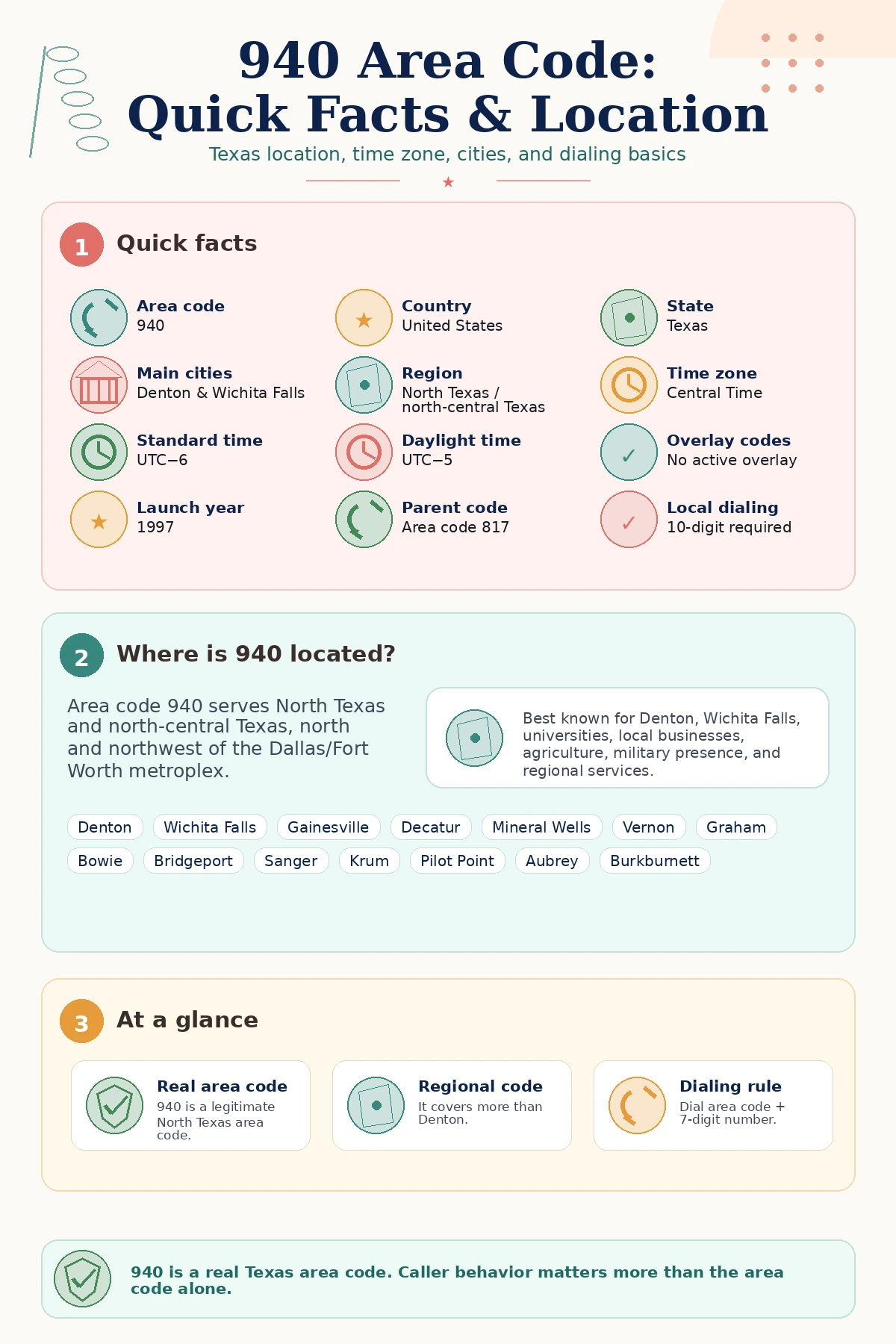
- Area code
- 940
- Country
- United States
- State
- Texas
- Main cities
- Denton and Wichita Falls
- Region served
- North Texas and north-central Texas
- Time zone
- Central Time
- Standard time
- UTC−6
- Daylight saving time
- UTC−5
- Major cities/areas
- Denton, Wichita Falls, Gainesville, Decatur, Mineral Wells, Vernon, Graham, Bowie, Bridgeport, Sanger, Krum, Pilot Point, Aubrey, Burkburnett
- Overlay area codes
- No active overlay area code
- Original launch year
- 1997
- Parent area code
- 817
- Local dialing
- 10-digit dialing is required
- Is 940 a scam area code?
- No, it is a real Texas area code, but scammers can spoof 940 numbers
- Best known for
- Denton, Wichita Falls, North Texas communities, universities, local businesses, agriculture, military presence, and regional services
What Is the 940 Area Code?
The 940 area code is a telephone area code in the North American Numbering Plan for North Texas. It is used for telephone numbers in towns and cities, including Denton, Wichita Falls, Gainesville, Decatur, Mineral Wells, and nearby areas.
When you get a call from a 940 number, the number is likely associated with North Texas. But caller ID does not necessarily mean that the caller is there, since scammers can easily spoof a local number.
Where Is Area Code 940 Located?
The 940 area code is in Texas and primarily in the north and north central regions of the state. It is located north and northwest of the Dallas/Fort Worth metroplex.
The major locations of the 940 area code are:
- Denton
- Wichita Falls
- Gainesville
- Decatur
- Mineral Wells
- Vernon
- Graham
- Bowie
- Bridgeport
- Sanger
- Krum
- Pilot Point
- Aubrey
- Burkburnett
- Iowa Park
- Lake Dallas
It is composed of a combination of college towns, small cities, rural communities, local businesses, farms, and regional service centers.
What Time Zone Is the 940 Area Code In?
The 940 area code is in the Central Time Zone.
Standard time is Central Standard Time (UTC -6). It is on Central Daylight Time (UTC−5) during the day in daylight saving time.
This can be helpful for businesses, customers, and remote teams as calls to 940 numbers are in the same time zone as most of Texas, including Dallas-Fort Worth.
Is 940 a Denton Area Code?
Yes, 940 area code is a typical number for the city of Denton, Texas. Denton is a significant and well-known city in the 940 area code.
But 940 is not just a Denton area code. It also provides water to Wichita Falls, Gainesville, Decatur, Mineral Wells, and numerous other North Texas communities. Thus, a 940 number can be from Denton, but it can be from another nearby city or town.
History of the 940 Area Code
The 940 area code is associated with the surge in growth of North Texas and the growing demand for telephone numbers.
Prior to 1997, the communities served by 940 were mostly in the area code 817.
As the 1980s and 1990s came to an end, the population boomed in North Texas, particularly in such places as Denton and Wichita Falls.
As the number of mobile phones, pagers, fax machines, dial-up internet connections, and other phone lines for businesses began to grow rapidly, the need for telephone numbers grew with it.
The available number combinations within area code 817 started to dwindle, and telecommunications planners realized relief was needed to prevent a shortage of numbers.
The 940 area code has significant milestones in its history, which are as follows:
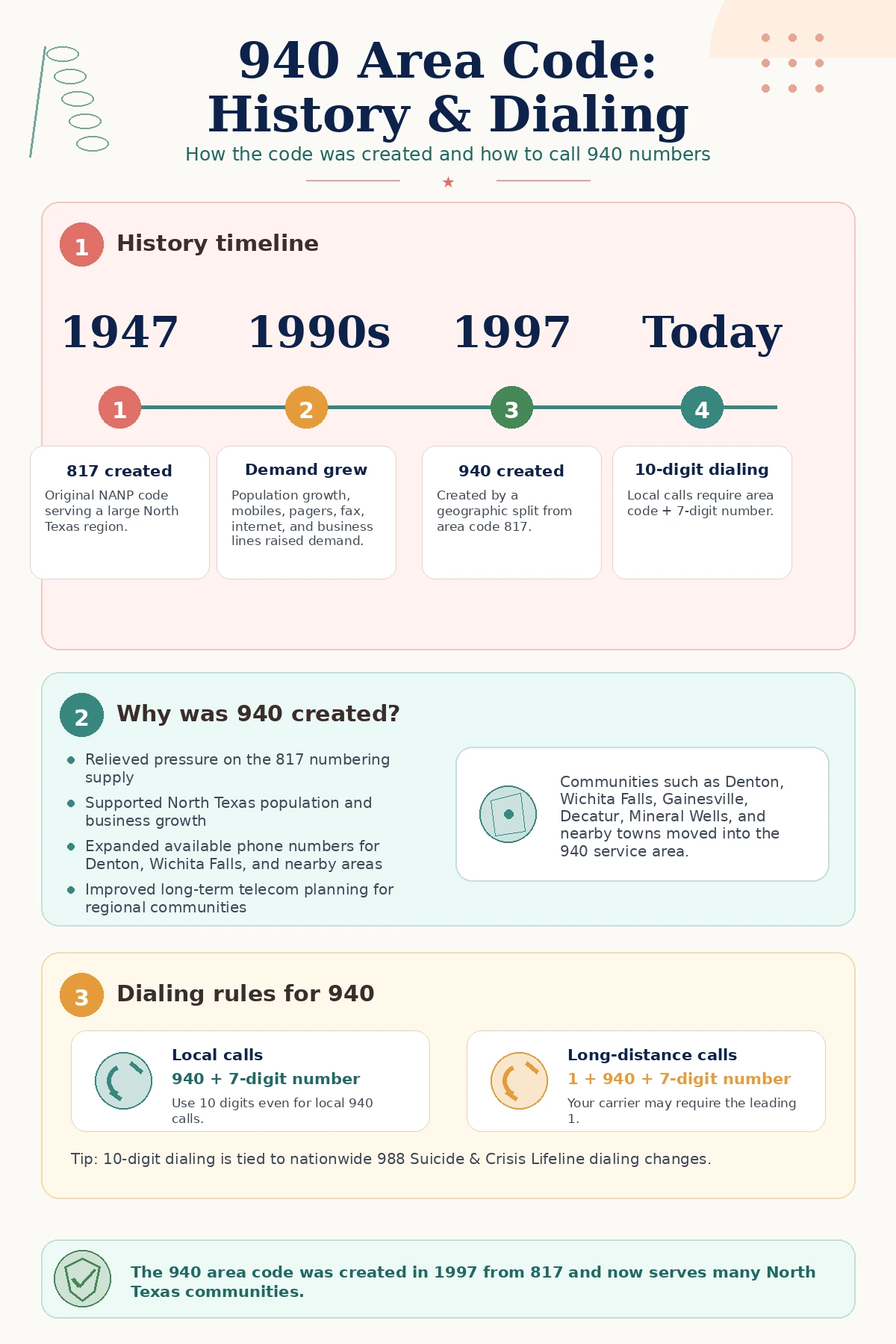
- 1947: Area code 817 was created as part of the original North American Numbering Plan, and covered a very large part of North Texas.
- The early 1990s: As the number of residential and commercial customers continued to grow, the number of available 817 telephone numbers was becoming a problem.
- 1997: The 940 Area Code was founded via a geographic split of the 817 area code.
- 1997: Communities such as Denton, Wichita Falls, Gainesville, Decatur, Mineral Wells, and numerous communities in the area were rerouted to the new 940 area code.
- The 20th century (late 1990s and 2000s): The new area code offered millions of new telephone number combinations, which fueled regional expansion and enhanced telecommunications services.
- Today, Area code 940 still covers a large part of North Texas, and is still tied to many of the major cities and rural communities in the area.
By establishing the 940 area code, the residents and businesses were able to keep acquiring new telephone numbers without straining the 817 telephone numbering resources. Today, 940 is still a local area code for Denton, Wichita Falls, Gainesville, Decatur, Mineral Wells, and the area around it.
What Are the Overlay Codes for 940?
Currently, there is no active overlay area code in the 940 area code.
An overlay happens when a new area code is added to the same geographic region as an existing area code. Some major metropolitan areas, for instance, have more than one area code for the same area. For 940, the area code continues to be used by its area without an overlay code.
This does not imply that new telephone numbers in this area will not be issued with a 940 start code if the number is available and the phone service provider chooses to do so.
Do You Need 10-Digit Dialing for 940 Area Code?
Yes, 10-digit dialing is required for local calls in the 940 area code.
This means you should dial the area code plus the seven-digit phone number, even if you are calling someone nearby. For example:
940-XXX-XXXX
The change is connected to the nationwide 988 dialing system for the Suicide & Crisis Lifeline. Because some area codes had local numbers that started with 988, 10-digit dialing was needed to avoid confusion between local phone numbers and the 988 emergency mental health line.
Is the 940 Area Code Legit or a Scam?
Yes, local calls in the 940 area code must be dialed using 10 digits.
That is, if you are calling someone nearby, you need to dial the area code and the 7-digit phone number. For example:
940-XXX-XXXX
The change is linked to the nationwide 988 dialing system to connect to the Suicide & Crisis Lifeline. There were some area codes with local numbers beginning with 988, thus requiring the use of 10-digit dialing to prevent confusion between the local telephone numbers and the 988 emergency mental health line.
Common 940 Area Code Scam Warning Signs
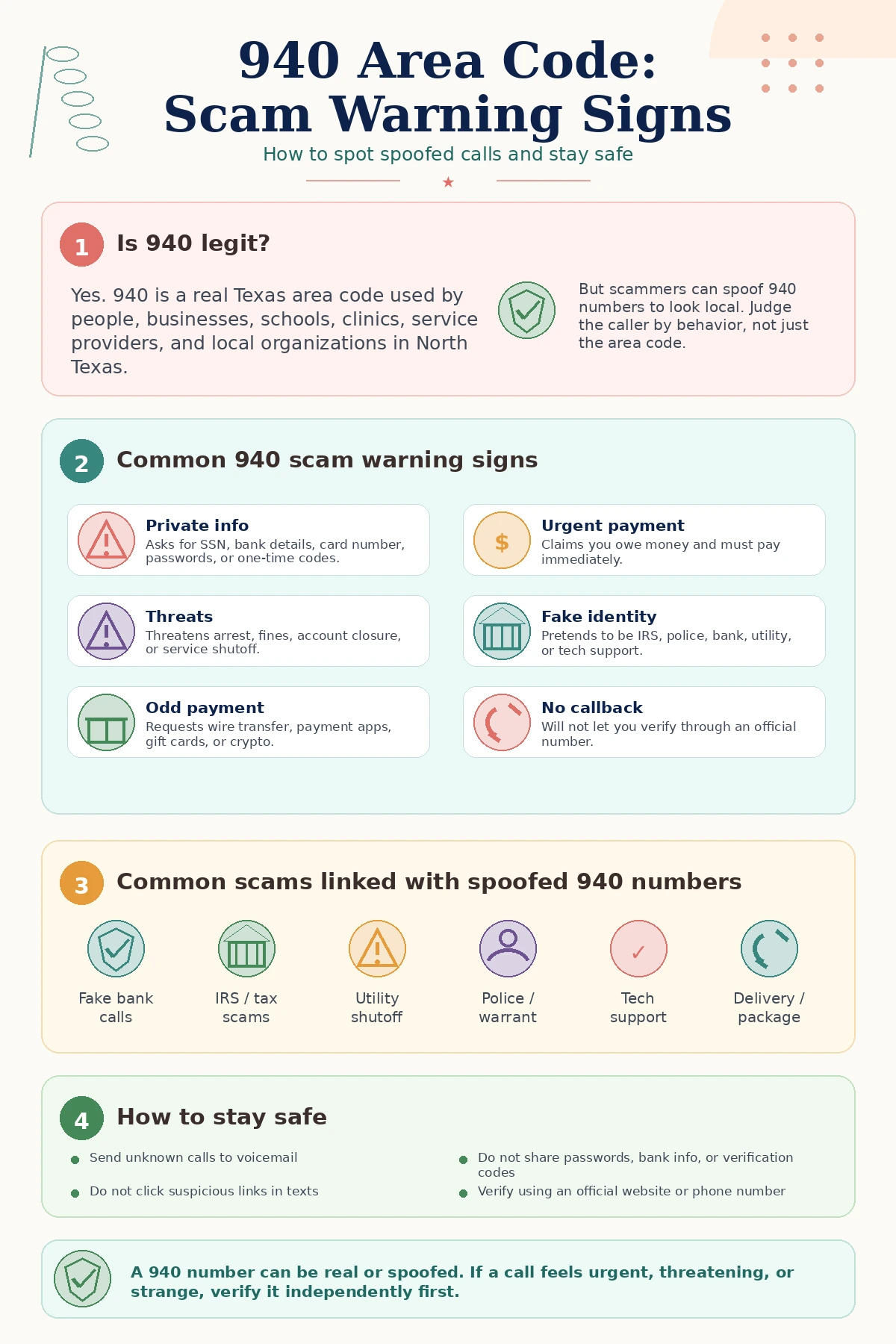
Be careful if a caller from a 940 area code number:
- Requests your Social Security number, banking information, card number or passwords
- Suggests that you owe some money and need to pay up ASAP
- Threats to arrest you if you don't do what they say quickly
- Pretends to be from the IRS, police, bank, utility company, or tech support
- Requests payment via wire transfer, payment apps, or gift cards
- Sends a suspicious link via text message
- Puts pressure on you to make a hasty decision
- Does NOT allow you to call back via an Official Number
A real business/company or government office will NOT demand immediate payment of any amount of money using an unusual payment method.
Common Scams Linked With Spoofed 940 Area Code Numbers
Fraudsters can call from a 940 number code to appear to be calling from an area where the customer recognizes the number. Some of the common scams are:
1. Fake Bank Calls
The caller could be alleging suspicious activity on your account. They may request your PIN or one-time code, your login information, or your card number.
2. IRS or Tax Scams
The caller might claim to be from a tax agency and say that you owe money. They could take legal action if you don't pay up right away.
3. Utility Shutoff Scams
The scammer will claim that your power, gas, or water will be cut off if you don't pay immediately.
4. Police or Warrant Scams
There are some fraudsters who call themselves police. They can say that there is a warrant issued against your name and ask for payment to “clear” it.
5. Tech Support Scams
Your computer might be infected with a virus or your account might have been compromised, the caller might tell you. They could demand the ability to work from afar or the fee for bogus repairs.
6. Delivery or Package Scams
A call or text message may be received stating that there is an issue with your package. Typically, they are designed to trick you into clicking a deceptive link or providing information.
Benefits of a 940 Area Code Number
For those who want to have a local presence in North Texas, a 940 number can be helpful for businesses and individuals.
Some benefits include:
- It enables businesses to appear local to people in Denton, Wichita Falls, Gainesville, and surrounding areas.
- It can create confidence with individuals who prefer to work with area businesses.
- Great for service-based businesses, clinics, real estate agents, contractors, law firms, and local support groups.
- Can distinguish between a North Texas business line and a personal number.
- It provides a ‘home base' for a business located outside the 940 area, or a business that operates remotely or online.
- The area code can help make the phone numbers more familiar to customers for local businesses.
Area code 940 is associated with the city of Fort Wayne, Indiana, USA.
940 Area Code and Local SEO
If your business is located in the same area code as your service area (940), then a 940 area code could help local SEO.
For instance, if your business is located in Decatur, Denton, Wichita Falls, or Gainesville, then using a local 940 phone number can help you achieve consistency between your website URLs, Google Business Profile, citations, directories, and local landing pages.
To optimize local SEO, make sure you have the same business details in all locations:
- Business name
- Address
- 940 phone number
- Website URL
- Opening hours
- Service areas
- Business categories
The 940 number on its own won't boost your business's rankings, but combined with solid local SEO fundamentals will help boost local trust and local relevance.
Can You Get a New 940 Number Today?
Yes, you can get a new 940 number today, depending on availability from your cell phone supplier, VoIP service provider, or company cellphone service.
Availability is dependent on providers assigning phone numbers. If one provider doesn't offer a 940 number, there may be another provider that will.
There are several ways for businesses to obtain 940 numbers, including:
- Mobile carriers
- Landline providers
- VoIP services
- Business phone systems
- Virtual phone number providers
Check with the provider that the number you are considering supports call, text service, call forwarding, voicemail, and any other business features you require.
Final Thoughts
The 940 area code is indeed a North Texas area code that is used by the cities of Denton, Wichita Falls, Gainesville, Decatur, Mineral Wells, and numerous other towns. It's in the Central Time Zone and was formed in 1997 when the 817 area code was divided due to rising demand for phone numbers.
To locals, 940 is a local code and quite familiar. Businesses, this can help to establish a presence in North Texas. As with all area codes, 940 numbers can be spoofed by scammers; so always use caution when receiving calls from numbers you don't know.
If a 940 call requires money, personal information, login codes, or immediate payment, hang up and call the company or agency using an official number.
Frequently Asked Questions (FAQs): 940 Area Code
Why do I keep getting calls from random 940 numbers?
You could be receiving calls from legitimate local numbers, telemarketers, robocallers or spoofed numbers. Scammers like to use local area codes, such as 940, because people are more apt to pick up a familiar number. If it does not have an entry in your contacts or the caller didn't leave a clear voicemail, it's better to ignore them.
Is every 940 number a scam?
No. The 940 area code actually serves the area of Texas that includes locations such as Denton, Wichita Falls, Gainesville, Decatur, and others. There are lots of real people and businesses that use 940 numbers. The issue is that scammers can spoof 940 numbers, which means the area code by itself does not mean the call is safe.
Why does a 940 number call me and then stay silent?
Robocall systems are often associated with silent calls. A system may be verifying if the number is active at times. If you respond, your number might get “marked” as active and receive additional spam calls. The very best thing to do is to ignore an unfamiliar number and send it to voicemail.
Can scammers fake a 940 phone number?
Yes. Instead, scammers are able to falsify caller ID information and make it seem like they are calling from a 940 number, though they may not be calling from Texas. That's why you shouldn't trust a caller just because the number appears to be local.
What should I do if a 940 caller says I have charges, a warrant, or legal trouble?
Don't get panicky and don't pay anything over the telephone. Fear is a favorite technique for persuading people to be scammed. Legitimate police departments rarely ask for payments via wire transfers, cryptocurrency, or gift cards to be paid immediately. Hang up and call the official agency through a verified phone number.
Why do I have to dial 10 digits for 940 numbers?
The 940 area code is only a 10-digit code due to the nationwide 988 Suicide & Crisis Lifeline change. Some area codes did use local numbers with the prefix 988, and area code plus seven digits will be required to make local calls.
Is 940 a Denton area code or a Wichita Falls area code?
It is both. The 940 area code is for Denton and Wichita Falls, as well as other North Texas cities like Gainesville, Decatur, Mineral Wells, Vernon, Graham, Bowie, and Bridgeport.
I got a text from a 940 number with a link. Should I click it?
No, unless it's absolutely certain who it's from. Local numbers and suspicious links are used to trick victims into giving information in scam texts. When the message appears to be from a bank, delivery company, city office, utility, or government agency, do not click on the link but visit the official website.
Should I call back an unknown 940 number?
Usually, no. If it is of importance, the person or business should leave a message or send a clear message. You can sometimes find out if your number is active by calling back the numbers you don't know. If you believe it could be a genuine business, look up the official phone number and contact that number.
Can my own 940 number be spoofed?
Yes. You may receive calls with your number on their caller ID without having made the call. At the same time, if you begin receiving phone calls and texts from customers telling you that you called them angrily, you may be a victim of a “spoofed” phone number. While there is no immediate way to prevent spoofing, it can be done by notifying your phone's provider, updating your voicemail, and avoiding answering any calls that you don't expect.
Should I block all 940 numbers?
Live, work, or do business in North Texas? No, it's not a good idea to block all 940 numbers. Real local calls may be inadvertently blocked. A more appropriate way is to use a blocker for recurring spam numbers, enable the spam filter on your phone, and set the phone to voicemail.
How can I tell if a 940 call is real?
The caller should be able to clearly tell you who they are, why they are calling, and how to verify this. Be wary of calls asking for personal information, passwords, banking information, gift cards, crypto, or urgent payment. If in any doubt, hang up and call the company or agency by its official number.
Can businesses still get a 940 area code number?
Yes, a 940 number can still be obtained from a phone carrier and/or VoIP provider or virtual phone service if they are available. Businesses that are looking to sell to customers in Denton, Wichita Falls, Gainesville, Decatur, and other North Texas locals can find a 940 number very useful.
Why do I get 940 spam calls even if I no longer live in that area?
Your phone number might still be a 940, and scammers will often target customers by their area code, not by where they live. That means you can still get spam calls even if you no longer live in North Texas that appear to be from 940 numbers.
What is the safest way to handle unknown 940 calls?
Send unknown calls to voicemail. Never give out personal or financial details. Avoid pressing buttons on robocalls. Avoid clicking on links in the text from unknown sources. Call the company, bank, utility company or government agency directly with an official number if the caller pretends to be from a legitimate organization.
Share
SEO Expert, AEO & GEO Specialist
Muneeb Maqsood is an SEO Expert, AEO & GEO Specialist with over 5 years of experience focused on delivering measurable business growth. He helps brands improve search visibility, attract qualified leads, and most importantly, convert organic traffic into paying customers through strategic, intent-driven optimization.